
Who works to define "sex" to restrict bodily autonomy?

In 2021, state legislatures began introducing healthcare bans to deny care to transgender youth. These healthcare bans rested on legally defining "sex," leaning on medicine to verify sex and enforce options available for patients' bodies. Anti-trans policy language quietly began including exceptions to continue forced surgeries on intersex infants and children.
This double standard reflects the long-standing partnership between states and medical establishments in the violent enforcement of body-gender norms. Whether for or against healthcare for transgender people, media discussions of healthcare bans offer only rare or limited mention of intersex people. Driven by this erasure, SLIM works to understand who drives these policy initiatives and why. By mapping authorship and financial relationships, we can understand why intersex children and young adults continue to be targets of medical and state violence, at the expense of our transgender siblings.
SLIM's map, created with tools from LittleSis, highlights the actors behind anti-intersex, anti-autonomy policy. Smaller nodes represent organizations which may be common names in the media—such as Do No Harm, Genspect, and Focus on the Family—but which wouldn't exist without deeper financial backing. Larger nodes represent the well-funded groups—like the DeVos Family Foundation, the Lynde and Harry Bradley Foundation and Donors Trust—behind them.
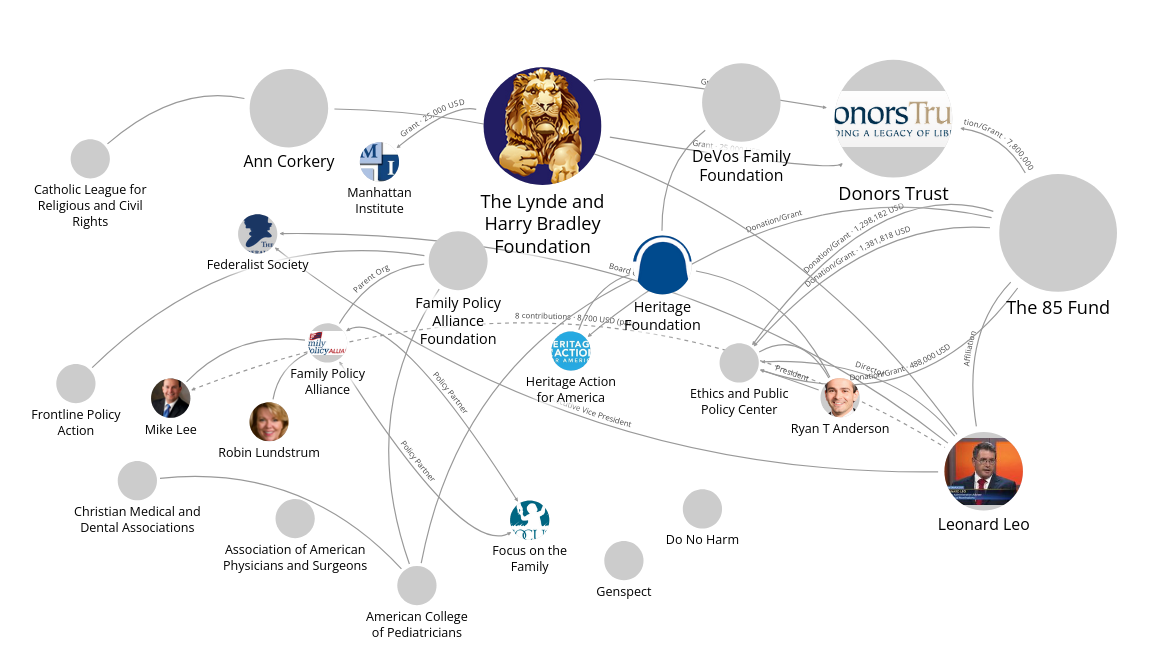
Analysis
Why the focus on defining "sex?" What are the broader concerns?
An essential component of fascism is defining women. Transgender women and intersex women upset and upend traditional notions of what constitutes a woman. Intersex women expand the category of woman. The goal of anti-trans healthcare bans with intersex exceptions is to enshrine a particular definition of sex into law.
Jay Richards, who is affiliated with the Heritage Foundation, warned about what he saw as the imminent threat of gender identity: "In sum, current efforts to redefine sex to include 'gender identity' would dissolve sex as a stable legal category and create legal chaos. In response, public institutions must shore up their defenses."
What do anti-transgender policies say about intersex variations?
Our reseach reveals the ecosystem of organizations who are actively attacking bodily autonomy while dismissing intersex as a disorder affecting "men" and "women." For the purposes of circumventing trans people who reference intersex variations as proof that biological sex (and by extension, gender) exists on a spectrum, conservatives have dominated the discourse by asserting that intersex traits are "rare medical conditions" that do not constitute an identity or are related to gender.
The following are policy statements about intersex from right wing organizations:
While disorders of sexual development, often mislabeled 'intersex' conditions, do occur, they do not prove that there are more than two sexes—or that the sexes are somehow fluid or mere endpoints on a spectrum. Such disorders occur in only 0.018 percent of the population, and those with atypical chromosomes or sex traits are still either male or female.—Heritage Action for America
Intersex disorders – which are exceedingly rare – differ from a person identifying as transgender in that intersex disorders are medically verifiable by tests, whereas identifying as transgender is something that’s simply self-asserted. Intersex disorders are true medical problems that at times may be life-threatening. Contrary to some faulty assertions, intersex disorders are not proof of a gender spectrum.—Family Policy Alliance
Intersex people, whose genitalia appear ambiguous or mixed, don’t undermine the sex binary. Many gender ideologues, however, falsely claim the existence of intersex conditions renders the categories 'male' and 'female' arbitrary and meaningless. But 'intersex' and 'transgender' mean entirely different things. Intersex people have rare developmental conditions that result in apparent sex ambiguity. Most transgender people aren’t sexually ambiguous at all but merely 'identify' as something other than their biological sex.—The Manhattan Institute
While some might attribute these views to active hatred of transgender and/or intersex people, far right and conservative foundations such as 85 Fund and the Lynde and Harry Bradley Foundation focus on broader platforms attacking social welfare. Civil rights may be tolerable sacrifices in allying with religious groups over a shared interest in capital.
A great example of this is from a 2021 article in The Nation, "Dark Money, the Supreme Court, and the Fate of LGBTQ+ Rights." In this article, David Koch describes ignoring attacks on queer rights to work with partners on an agenda promoting fossil fuels and climate catastrophe: "That’s their problem. I do have those views... What I want these candidates to do is to support a balanced budget."
Which groups are worth watching?
Although the following groups are not directly targeting intersex organizers, they're ones to watch:
- Society for Evidence Based Gender Medicine (SEGM)
- America First Policy Institute (AFPI)
- Alliance Defending Freedom
- American Principles Project
- Faith and Freedom Coalition